
Five self-paced stages, from first steps to portfolio
Branchout takes you from choosing a track to a published portfolio in five self-paced stages. Every track follows the same path; what you build along it depends on the track you choose.
Stage 1 of 5
Plant roots
Create your profile, choose your track and see what it covers.
Tell us where you are starting from and pick one of six tracks. Each track sets out the skills it covers and the project it builds toward, so you can skip what you already know and start where you need to. Most people finish this stage in a weekend; take the time you need.
- Create a free account and fill in your profile
- Choose a track (you can switch later)
- Upload a resume if you have one, to pre-fill your profile
- Check what your track covers and decide what to learn first
Ready to move on when: You have chosen a track and know what to learn first.
Stage 2 of 5
Foundations
Work through your track’s learning material at your own speed.
Self-guided material for your track, with a volunteer mentor to ask when you get stuck. Your pod has a target finish date to plan around, but nothing is lost if it slips, so move faster or slower around classes, work and life.
- Work through your track’s learning material in the order that suits you
- Ask a volunteer mentor when you get stuck
- Build small exercises that prove each skill to yourself
Ready to move on when: You can use the basics of your track’s stack without step-by-step instructions.
Stage 3 of 5
Project sprint
Join a pod of up to six and build a production-style project brief.
Pods are small groups working on the same brief, modelled on a real startup problem. The work is educational: it is for your learning and your portfolio, not for any company’s commercial gain.
- Join a pod of up to six students on the same brief
- Plan the work together and split it into pull requests
- Review each other’s code before it merges
- Ship a working, deployed project
Ready to move on when: Your pod’s project runs, and you can explain every part you built.
Stage 4 of 5
Lead and reflect
Optionally lead a pod, support newer students, and review what you learned.
Leading a pod is optional. It is practice in planning work, reviewing code and unblocking others: the skills that come up in every interview about teamwork. Then you reflect on what you built.
- If you choose to, lead a pod: plan the work, review it, unblock people
- Help newer students with what you have learned
- Write a short reflection on what went well and what you would change
Ready to move on when: You can describe how you work in a team, with real examples.
Stage 5 of 5
Share your portfolio
Publish your shipped work and earn your certificate of completion.
You keep full ownership of everything you build. Publish it, earn your certificate when a mentor passes your pod’s project, and take both into interviews.
- Publish your project with a clear write-up of how you built it
- Get your free certificate when a mentor passes your pod’s project, and share its code with employers
- Take your portfolio into applications and interviews
Ready to move on when: Someone who has never met you can see what you can build.
Built around your life, not a timetable
Nothing is lost if a date slips. Move faster in the holidays, slower in exam season, and pause when life gets busy. Your track and your pod work around you.
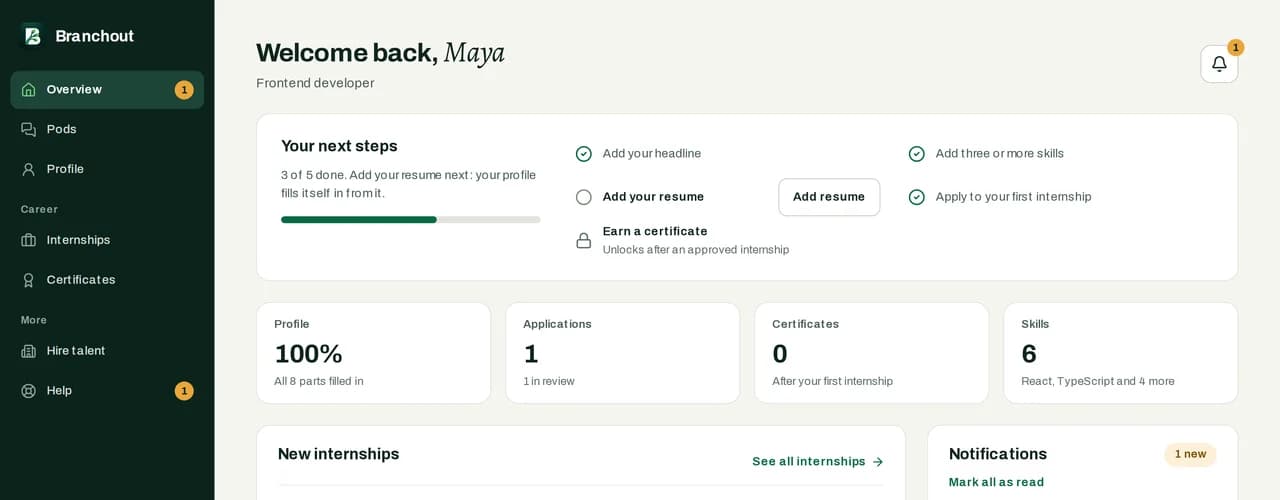
Your dashboard shows what to do next
It lists your next steps, new internships and where each application stands. Your profile, your pod and your certificate are in the same place.
What it costs
Everything’s included, free
Bootcamps and paid courses often cost thousands of dollars. Branchout charges students nothing, and signing up doesn’t ask for a card.
What every student gets
- A self-paced learning path for your track
- Six learning tracks, and you can switch between them at no cost
- A pod of up to six students working on the same brief
- Support from volunteer industry mentors
- Production-style project briefs based on real startup problems
- A certificate of completion
- A portfolio you fully own and keep
What it isn’t
Free doesn’t mean it’s a job. Branchout is an educational program, and it’s plain about what it doesn’t offer.
- Not a job
- Branchout is unpaid and educational. There are no wages, no fixed hours, and no one supervising you as an employee.
- Not a job guarantee
- The program does not promise employment, income or interviews. What you get is skills and work you can show.
- Not academic credit by default
- Branchout is not affiliated with any school. If you want credit, your institution decides; we can provide documentation.
How it compares
Differences in kind, not a league table. Bootcamps and self-study both work for many people; this is where Branchout is different.
| Branchout | A typical coding bootcamp | Learning on your own | |
|---|---|---|---|
| Cost to you | Free | Tuition fees | Free or low cost |
| Schedule | Self-paced, with target dates | Fixed, often full-time | Self-paced |
| Human support | Volunteer mentors and a peer pod | Instructors | Forums and communities |
| Team projects | Production-style briefs in pods | Often, within a cohort | Rare |
| Leading others | Optional pod lead role | Rare | Rare |
| You finish with | A portfolio and a certificate | A certificate and a portfolio | Whatever you build |
Cost to you
- Branchout
- Free
- A typical coding bootcamp
- Tuition fees
- Learning on your own
- Free or low cost
Schedule
- Branchout
- Self-paced, with target dates
- A typical coding bootcamp
- Fixed, often full-time
- Learning on your own
- Self-paced
Human support
- Branchout
- Volunteer mentors and a peer pod
- A typical coding bootcamp
- Instructors
- Learning on your own
- Forums and communities
Team projects
- Branchout
- Production-style briefs in pods
- A typical coding bootcamp
- Often, within a cohort
- Learning on your own
- Rare
Leading others
- Branchout
- Optional pod lead role
- A typical coding bootcamp
- Rare
- Learning on your own
- Rare
You finish with
- Branchout
- A portfolio and a certificate
- A typical coding bootcamp
- A certificate and a portfolio
- Learning on your own
- Whatever you build
Plant your roots
Create a free account, choose your track and start at your own pace. No card needed, and you can pause or leave at any time.